PLANTING
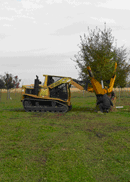
We start with the best and hardiest liners available from the top liner growers in the country. The bare root trees arrive into our warehouse in early March, where they are kept protected and moist. Planting begins in late March and is finished in early April when there is good soil moisture and soil temperatures allow the trees to leaf out slowly. Trees are planted 6' on center in alternating rows to allow enough room to grow and harvest. Holes are machine drilled to allow enough room for root structure, and properly backfilled for minimal settlement and proper trunk flare height. All liner stock is dipped in BioPlex’s Bareroot Root Inoculant prior to planting.
PRODUCTION
Thoms Farms, LLC takes an Integrated Pest Management approach towards its production. Nutrition is applied by granular fertilizers on a timely basis based on soil tests. Insect, disease, and vertebrate are carefully monitored, and once thresholds have been met, actions are taken that best meets our products and the environment. It is our feeling that vigorous, quality trees can only be produced where weeds are adequately controlled. We therefore control weeds by mowing, cultivating, and applying herbicides as needed. Corrective pruning and staking are undertaken throughout the season in order to better ensure a quality tree crown and straight trunk. We aspire not only to grow specimens that are indicative of their respective growth habits, but are exemplary in form.
These practices allows us to produce uniform trees with a heavy, balanced root system, which is one of the keys to the survivability of a newly planted tree in any landscape. It also allows you as a landscape contractor, nursery supplier, or institution to have the best plant material for yourself and/or your customer.
HARVESTING
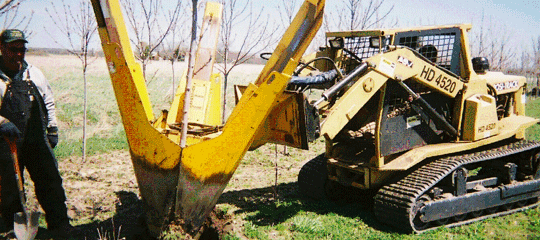
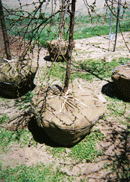
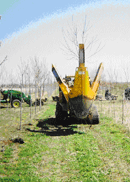
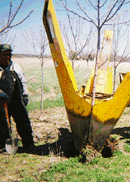
All trees are machine dug, using wire baskets, sisal twine, and 10 oz. treated burlap. Tree crowns are carefully tied, and trunk guards are used to prevent damage in shipping and planting. Ball sizes are always oversized in comparison with the American Standards for Nursery Stock. All ball and burlap harvested tree are recommended to be dug in the spring of the year before leaf out (March-May). Fall digging (November-December) can take place once trees go into dormancy, but the following plants are not recommended for fall digging:
- Autumn Blaze Maple
- Red Sunset Maple
- Betula – Birches
- Carpinus
- Crataegus – Hawthorns
- Gleditsia – Locust
- Ginkgo Trees
- Nyssa sylvatica
- Prunus – Cherries
- Pyrus – Pears
- Quercus – Oaks
A 25% surcharge for the use of Bio-Plex’s Transplant Concentrate & Plant Enhancer for summer digging of all trees and fall digging of the above listed plants will be added to current pricing.
[find out more about our location >>] |